Key takeaways
- Discord crypto scams usually exploit trust moments, not just open chat: fake verification, fake claims, impersonated mods, compromised accounts, and rushed announcements.
- Token gating is one security layer. It keeps private holder spaces cleaner, but it does not replace permissions, moderation, link discipline, or incident response.
- Permissions matter more than warning messages. A single overpowered bot, webhook, or contractor role can create more risk than a hundred random spammers.
- One official-links channel and a no-DM support policy reduce the number of moments where holders have to guess what is real.
- Recurring holder checks keep Discord roles and Telegram access aligned with current SPL token or NFT ownership.
Discord crypto scams are social-engineering attacks that borrow trust from your server. The fake mint link works because it appears during mint week. The fake verification page works because members expect to verify. The fake support DM works because the scammer copied a mod name and caught a holder while they were already stressed.
The way to stop Discord crypto scams is not one bot, one warning banner, or one holder verifier. The practical answer is a layered operating system: lock permissions, centralize official links, use Discord safety tools, train moderators, separate public and holder spaces, and use Solana token gating as the holder-access layer.
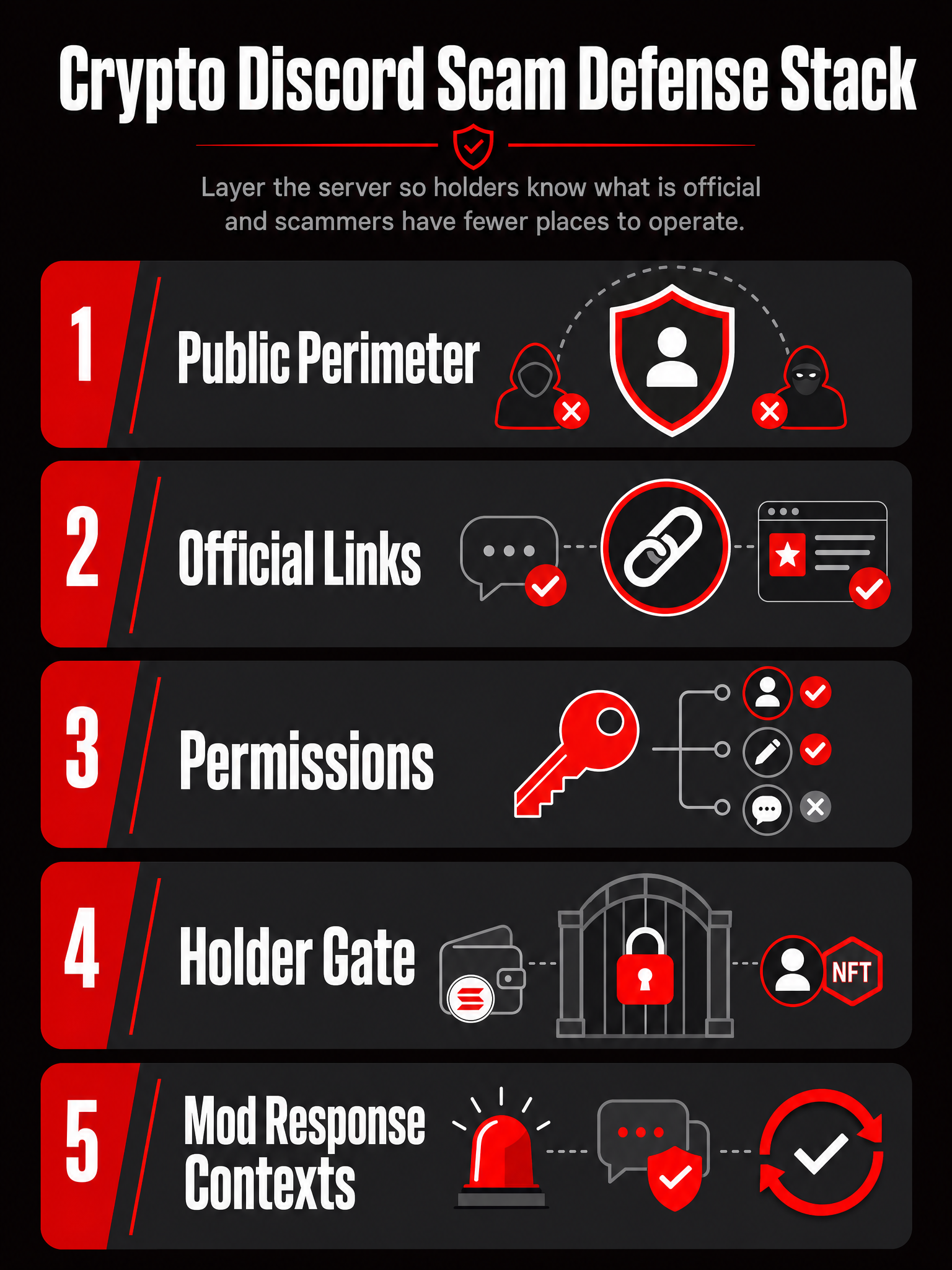
Scam defense works best as a stack: Discord controls reduce chaos, permissions reduce blast radius, and token gating keeps holder spaces cleaner.
What crypto Discord scammers actually exploit
Most teams think scammers want access to every channel. In practice, scammers want access to the moments where members are easiest to pressure:
- mint windows
- airdrop claims
- staking launches
- whitelist announcements
- token migrations
- support tickets
- collab requests
- mod hiring
- role verification
- panic during raids
The common patterns are painfully familiar:
- Fake verification. A bot or copied team account sends users to a fake holder verification page.
- Fake claim links. A scammer posts a claim, mint, or refund link during a real campaign.
- Impersonated team DMs. A fake mod says, "open a ticket here" or "verify again now."
- Compromised accounts. A real-looking account posts malicious links after being phished.
- Webhook or announcement abuse. A weak webhook or overpowered bot posts inside a trusted channel.
- Raid chaos. Bots flood chat so members miss the real warning and click whatever is repeated most.
- Mod-targeted scams. Attackers send files, fake collaboration tools, or fake hiring tasks to admins and moderators.
Discord’s own safety guidance warns users not to click unfamiliar or unexpected links, not to download unfamiliar files, and to report suspicious bots asking users to click links or add them to servers. Discord also recommends password resets and 2FA after account compromise. (discord.com)
For Web3 communities, there is one extra twist: scammers imitate the exact flows your holders already expect. Check Point Research documented a 2025 phishing campaign involving Discord, a fake holder-verification flow, and a crypto drainer. The useful lesson is not that verification is bad. The lesson is that verification must be clearly official, predictable, and never delivered through surprise DMs. (research.checkpoint.com)
A safe crypto Discord is not a server with no scammers. It is a server where scammers have fewer places to reach holders, fewer permissions to abuse, and fewer moments where members have to guess what is official.
What token gating can and cannot do
Token gating helps by reducing who can enter high-trust rooms. For a Solana community, that usually means checking whether a wallet holds a required SPL token balance or a required Metaplex NFT, then assigning the right Discord role or Telegram access after the member proves wallet control with a wallet signature.
With Ancla, the community sets token or NFT rules, gates Telegram and Discord communities to token holders, and removes members who sell below the gating condition. Ancla’s site also says it supports Solana only for now and offers recurring community checks depending on plan. Checked July 3, 2026. Plans and packaging can change. (ancla.club)
That makes token gating useful for:
- holder-only Discord channels
- whale rooms
- NFT owner support
- campaign planning rooms
- Telegram alpha groups
- contributor or OG rooms tied to onchain ownership
- removing sellers when they no longer meet the access rule
Token gating protects the room. Permissions and communication protect the people inside it.
Token gating does not do these things:
- identify the real-world person behind a wallet
- stop a verified holder from being compromised
- validate every link posted in chat
- protect a mod who signs a malicious transaction
- secure a webhook with too many permissions
- replace Discord AutoMod, slowmode, verification levels, or raid response
- make public channels safe by default
Discord account verification is also not the same as wallet verification. Discord Verification Levels control what account conditions a member must meet before sending messages, such as email, account age, server membership time, or phone requirements depending on the level. Wallet verification checks onchain ownership. You need both concepts, but they solve different problems. (support.discord.com)
For a deeper breakdown of holder verification on Solana, read Solana Token Gating: The Complete Guide for Community Founders.
The practical Discord security stack
A serious crypto Discord should be designed like a venue with zones. Public channels are the perimeter. Holder rooms are controlled access. Announcements are locked lanes. Moderator channels are the control room.
| Layer | What it blocks | What it does not block | Owner |
|---|---|---|---|
| Verification Level | Some low-effort spam accounts from immediately posting | Wallet drainers, fake links, compromised real accounts | Admin |
| AutoMod | Keyword spam, mention spam, repeated raid messages | Bots and webhooks exempt from filters, every malicious link | Mod lead |
| Raid Protection and Security Actions | Join-raid pressure, invite abuse, DM spread during incidents | All social engineering, all compromised accounts | Admin plus active mods |
| Locked announcements | Random users posting official-looking updates | A compromised admin or webhook | Founder plus lead admin |
| Role hierarchy | Junior mods or bots changing higher roles | Bad decisions by top admins | Server owner |
| Official links channel | Link confusion during mints, claims, support, verification | Users who ignore warnings or trust DMs | CM |
| Token-gated channels | Non-holders flooding holder rooms | Scammers who buy access or compromise holders | Community ops |
| Mod SOPs | Slow or inconsistent response during raids | Lack of judgment, poor training, bad device hygiene | Mod lead |
Discord AutoMod can set keyword and spam filters that block messages, block spam, or log flagged messages for review. Discord also says built-in suspicious link and file detection is client-side, does not remove offending content, and should not be relied on as auto-moderation. (discord.com)
During raids, Discord recommends practical controls such as AutoMod, disabling @everyone and @here for non-trusted roles, Raid Protection alerts, Verification Levels, explicit media filters, pausing invites, slowmode, and tightening AutoMod rules while the raid is happening. (support.discord.com)
Lock down permissions before you add more tools
Most crypto Discord security failures are not caused by lacking another bot. They come from messy permissions.
Start with these rules:
- Keep Administrator limited to the absolute smallest group.
- Do not give Manage Server to convenience bots or temporary helpers.
- Put the token-gating bot role high enough to assign holder roles, but not higher than admin and security roles.
- Review Manage Roles, Manage Channels, Manage Webhooks, Ban Members, Kick Members, Mention @everyone, and Create Invite permissions.
- Remove @everyone and @here from non-trusted roles.
- Keep announcement posting limited to a tiny group.
- Audit every webhook used for sales feeds, mint alerts, marketplace alerts, and campaign posts.
- Remove access from ex-contractors, ex-mods, inactive collab managers, and abandoned bots.
- Keep an emergency role ready that can mute public posting during an incident.
Discord’s role hierarchy is central to server security. Members can only affect users with roles lower than their highest role, and Discord describes Administrator as the most powerful permission because it grants all permissions and bypasses channel restrictions. (support.discord.com)
Do the permission audit before the next launch, not after the first fake claim link lands in announcements.
A clean role stack might look like this:
- Owner
- Security lead
- Admin
- Bot roles that need role assignment
- Moderator
- Support
- Team
- Partner
- Contributor
- Whale
- Holder
- Verified
- New member
For holder segmentation ideas, see The Most Common Roles in NFT and Token Communities. The security point is simple: roles should express both access and risk.
Build a safer verification and support flow
The riskiest moments are the ones that feel routine. Verification. Claims. Support. Airdrops. Migrations. That is exactly why scammers copy them.
A safer flow has boring consistency:
- One official-links channel.
- One official verification route.
- One support entry point.
- No surprise DMs from staff.
- No claim links posted casually in general chat.
- No temporary mirror links without a signed announcement from the main team account.
- Pinned reminders before every mint, claim, staking update, or token migration.
Never make holders decide whether a random DM is official.
Use support macros that moderators can paste quickly:
- "Staff will never DM you first. Open support only through the ticket button in this server."
- "The only verification link is in #official-links. Ignore all other verification links."
- "Do not share seed phrases, private keys, wallet files, screen-share wallet approvals, or Discord tokens."
- "During claim windows, compare every link against #official-links before connecting a wallet."
This is also a marketing trust issue. Clean launch communication creates better campaign trust. Holder segmentation is stronger when members know which channels matter. Social proof is more credible when the holder room is not full of fake accounts farming attention.
Discord should be your structured base: roles, channels, announcements, mod logs, support, and holder rooms. Telegram is better for fast alerts, founder access, and urgent holder coordination. For Solana teams, the clean setup is to keep both aligned with the same ownership logic so a seller does not keep Telegram access while losing the Discord role.
For broader community structure, use How to Build and Grow a Web3 Community on Solana.
Raid and scam incident response checklist
Do not invent the response while the raid is happening. Put the checklist in a private mod channel and rehearse it before mint week.
When a raid, fake link, or compromised account appears:
- Freeze official posting. Stop announcements until the lead admin confirms the source.
- Pause invites. Discord supports pausing invite links during a raid, which lets the team slow incoming raiders without deleting every invite. (support.discord.com)
- Pause DMs if available. Discord Security Actions can pause invites and DMs between non-friends inside the server while moderators investigate. (support.discord.com)
- Enable slowmode in attacked channels. Use it to reduce message velocity and give mods room to act.
- Tighten AutoMod. Add repeated scam phrases, fake domains, copy-pasted claim text, and mention spam rules.
- Remove suspicious bots, webhooks, and roles. Check recent changes before banning random users only.
- Post one official warning. Pin it and repeat it from the known announcement lane.
- Rotate compromised credentials. Reset passwords, rotate bot tokens where needed, and enforce 2FA for affected admins.
- Collect evidence. Save user IDs, bot IDs, message links, domains, wallet addresses, screenshots, and timestamps.
- Report to Discord. Discord tells users to report suspicious bots and compromised-account issues through Trust & Safety. (discord.com)
- Publish a short postmortem if holders were exposed. Explain what happened, what links were malicious, what members should do, and what changed.
Keep the tone calm. Panic spreads faster than facts, and scammers use panic as distribution.
How Ancla fits into the stack for Solana communities
Ancla is the holder-access layer for Solana communities. It verifies onchain ownership of SPL tokens and Metaplex NFTs, lets members prove wallet control with a gasless signature, then assigns or removes access in Discord and Telegram based on the rules your team sets.
Use it to:
- gate Holder, Whale, NFT Owner, Contributor, or OG rooms
- keep private Discord channels limited to wallets that still qualify
- gate Telegram groups for faster holder coordination
- remove sellers when they fall below the rule
- run recurring checks so access does not drift from onchain reality
- reduce non-holder noise during launches, claims, and support spikes
Ancla’s public site states that communities can gate Telegram and Discord access to token holders, set their own rules, support token and NFT access, and remove sellers. It also states Solana is the currently supported network. Checked July 3, 2026. (ancla.club)
That does not make Ancla a complete anti-scam system, and it should not be treated like one. It does not do identity checks, KYC, liveness, age verification, AML, malware scanning, or link validation. It verifies holdings, not people.
The strongest setup is simple:
- public channels stay readable but tightly moderated
- official links live in one place
- announcements are locked
- high-risk permissions are scarce
- support never starts in DMs
- Discord and Telegram holder rooms are gated by current Solana ownership
- recurring checks remove members who no longer qualify
Teams comparing holder verifiers can use The Best Matrica Alternatives for Solana Communities separately, but scam defense should start with the operating model above. Pick the access layer after you know what rooms, roles, and incident workflows you need.
Try Ancla free at ancla.club/select-plan.
Trusted by Solana communities running on Ancla


Frequently asked questions
No. Token gating helps keep private holder spaces limited to wallets that meet an SPL token or NFT rule, but it does not stop every scam. You still need clean permissions, locked announcements, official links, moderator workflows, Discord safety settings, and a clear incident response plan.
Use one official-links channel, lock announcement permissions, repeat that staff will not DM first, keep support inside a known ticket flow, block fake domains with AutoMod where possible, and gate holder-only rooms so non-holders cannot flood trusted spaces. Do not let mint, claim, or verification links appear casually in general chat.
Freeze announcements, pause invites, pause DMs if available, enable slowmode, tighten AutoMod, remove suspicious bots or webhooks, post one official warning, collect evidence, rotate compromised credentials, and report abusive content or bots to Discord.
No. Discord Verification Levels check Discord account conditions before a user can send messages. Solana wallet verification checks whether a wallet controls the required SPL token or NFT. A serious server can use both, but they solve different problems.
A token-gating tool can run recurring checks against onchain holdings. If a member no longer meets the SPL token or NFT rule, the tool can remove the Discord role or Telegram access so private holder spaces stay aligned with current ownership.