Key takeaways
- Most NFT and token communities use the same role families: verified, holder, tiers, partner, contributor, mod, team, and governance.
- The Holder role is the foundation. Everything else becomes easier once the server knows who actually owns the asset.
- Tiered roles turn ownership into status. They work best when the ladder is simple and the perks are clear.
- Not every role should be token gated. Team, mod, contributor, and support roles often need manual control.
- Good role design reduces support work. Members should understand what they qualify for without asking a moderator.
Community roles are the operating system of an NFT or token server. They decide who gets access, who gets recognized, and which members should see the important rooms.
In Web3, roles matter even more because some of them can be tied to wallet holdings. A member does not need to prove they hold with a screenshot. They verify a wallet, the gate checks the asset, and the role updates automatically.
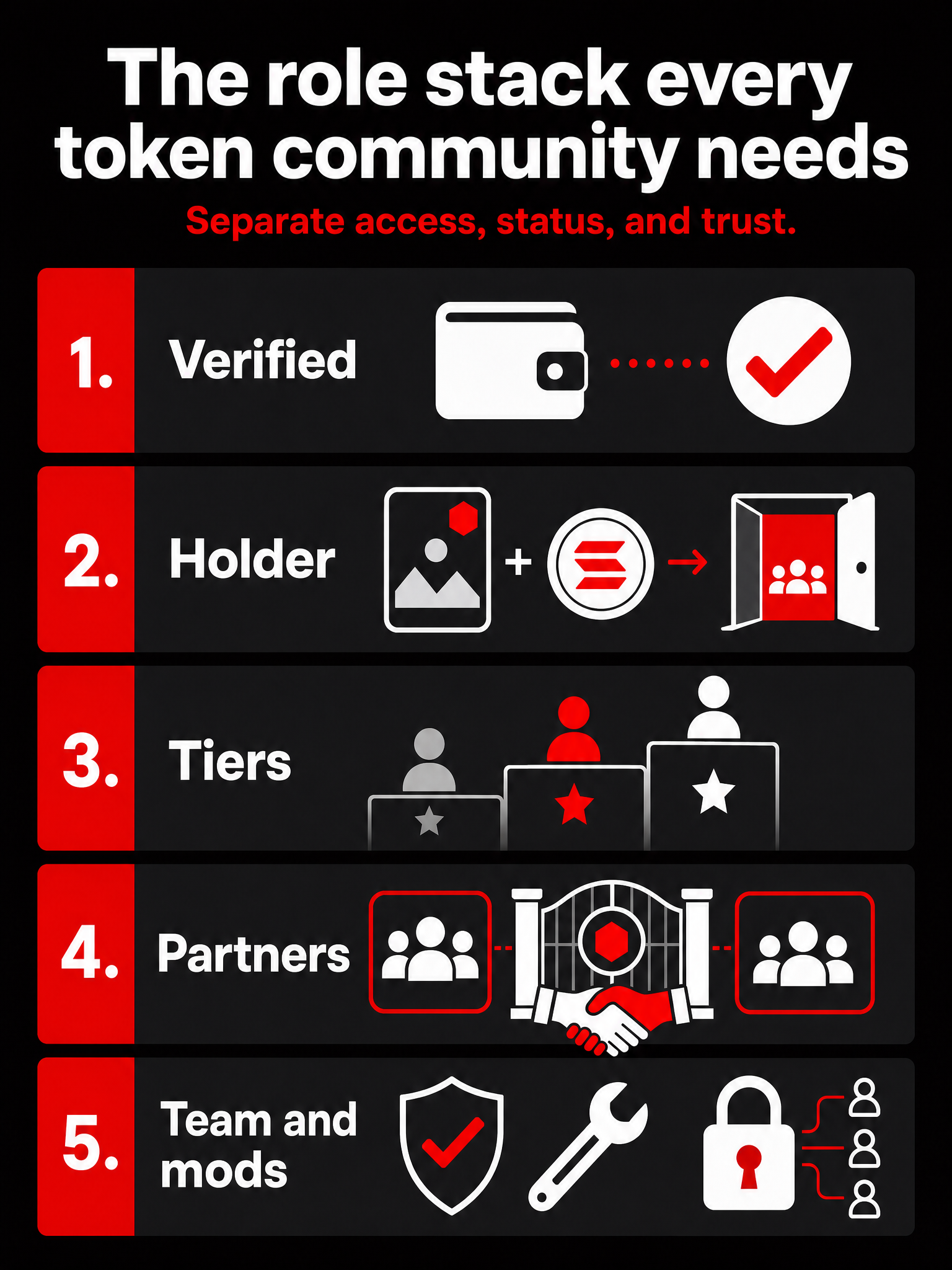
The best role systems separate wallet-based access from human trust and team operations.
Why roles matter
A flat server gets messy fast. Everyone sees the same rooms, everyone asks the same questions, and moderators have no clean way to separate real holders from visitors.
Roles solve three problems:
- Access: which channels can this member enter?
- Status: what should other members recognize about them?
- Operations: what permissions do team members, mods, and bots need?
The mistake is treating all roles the same. Some roles should be verified from the wallet. Some should be assigned by humans. Some should be temporary.
The Verified role
The Verified role means the member connected a wallet and proved control of it. It does not always mean they hold the project asset.
This role is useful when you want to separate real wallet-connected members from anonymous visitors. It can unlock a basic area or simply mark that the member passed the first step.
Do not confuse Verified with Holder.
Verified means:
This person controls a wallet.
Holder means:
That wallet holds the required token or NFT.
The Holder role
Holder is the universal Web3 community role.
For an NFT project, the rule is usually:
Hold at least 1 NFT from the collection.
For a token community, it might be:
Hold at least 1,000 SPL tokens.
This role should open the real discussion space. Not every holder needs special treatment, but every holder should have a room where the team can speak to people who actually own the asset.
Tiered holder roles
Tiers turn holdings into status.
Common examples:
| Role | Example rule | Use |
|---|---|---|
| Holder | 1 NFT or minimum token amount | Main access |
| Collector | 5 NFTs or higher token threshold | Deeper holder room |
| Whale | 10 NFTs or large token threshold | High-conviction access |
| OG | Early or long-term member | Culture and recognition |
Tiers work when they are legible. A member should know how to move from one tier to the next and what changes when they do.
Avoid creating six tiers just because you can. More tiers mean more permission checks, more questions, and more chances for disappointment.
Partner and collab roles
Partner roles are one of the most useful growth tools in Solana communities.
You can grant access to holders of another collection for a campaign, allowlist, event, or temporary channel. This makes partnerships feel concrete instead of being just two projects reposting each other.
Good partner roles have a clear end date or purpose:
- partner holder chat
- allowlist eligibility
- campaign room
- event access
- feedback group
If the access is temporary, say so upfront.
Contributor and ambassador roles
Contributor roles are about behavior, not holdings.
These usually include:
- ambassador
- creator
- alpha contributor
- community helper
- translator
- lore or meme contributor
Do not automate these purely from token balance. A whale is not automatically a good ambassador. A small holder can be one of the most valuable culture builders in the server.
Use wallet-gated roles for access. Use human judgment for trust and contribution.
Team, mod, and support roles
Team and mod roles should stay separate from holder roles.
This matters for security. A holder role should never grant moderation power. A mod role should never depend on a wallet balance. If someone sells an NFT, they should not lose mod permissions by accident. If someone buys 10 NFTs, they should not become a moderator.
Keep operational roles manual and tightly scoped:
- founder
- team
- mod
- support
- bot
- announcements
The fewer people who can post official links, ping everyone, or manage roles, the safer the community becomes.
Governance roles
Some communities use roles for voting or proposal access.
Governance roles can be based on:
- governance token balance
- NFT ownership
- long-term holder status
- council membership
- contributor nomination
Keep governance gates extra clear. Members get frustrated when they think they should be able to vote but the rule is hidden or ambiguous.
A starter role stack
If you are launching from scratch, start with this:
| Role | Gate type | Notes |
|---|---|---|
| Verified | Wallet signature | Optional first step |
| Holder | NFT or SPL token gate | Main access role |
| Core Holder | Higher threshold | Use only if it changes access |
| Partner | Partner collection or token | Campaign specific |
| Contributor | Manual | Based on behavior |
| Mod | Manual | Never tied to holdings |
| Team | Manual | Highest trust group |
This is enough for most early communities. Add roles when the community needs them, not because the role menu looks empty.
How to gate roles on Solana
For wallet-based roles, the flow is straightforward:
- Pick the role.
- Choose the Solana asset rule.
- Publish the official verification link.
- Let members connect a wallet and sign a free message.
- Assign the role when the wallet qualifies.
- Check again over time and remove access when the wallet no longer qualifies.
That last step is where serious gating shows. A holder role that never updates becomes a memory of who used to hold, not a reflection of who holds now.
For setup details, read How to Set Up Token-Gated Discord Roles on Solana. For the bigger gating model, read Solana Token Gating: The Complete Guide for Community Founders.
Ancla helps Solana founders map token and NFT holdings to Discord and Telegram access, then keep those roles aligned as wallets change.
Ready to organize your holder access? Start with Ancla at ancla.club/select-plan.
Trusted by Solana communities running on Ancla


Frequently asked questions
The most common roles are Verified, Holder, Whale or Big Holder, OG, Allowlist, Partner, Contributor, Moderator, Team, and sometimes governance roles.
Verified means a member proved control of a wallet. Holder means that verified wallet holds the specific token or NFT required by the community.
Tiered roles map holding bands to different access levels, such as Holder for one NFT, Collector for five, and Whale for ten or more.
No. Moderator, team, and support roles should usually be assigned manually because they represent trust and permissions, not only wallet ownership.
Yes. With recurring balance checks, a holder role can be removed when the wallet no longer qualifies for the rule.