Key takeaways
- An anti-raid bot helps, but it is not the whole security plan. Raids are stopped by layers: Discord-native controls, permissions, invite discipline, moderation workflows, and holder gates.
- Use Discord-native raid protection for the public front door. AutoMod, Raid Protection alerts, verification levels, slowmode, Pause Invites, and Security Actions should be ready before mint, reveal, listings, or major announcements.
- Protect holder rooms with token gates, not screenshots. For Solana NFT communities, map Metaplex NFT or SPL token ownership to Discord roles so real holders can enter and sellers can lose access.
- Permissions decide blast radius. A raid is annoying. A raid plus over-permissioned bots, open mentions, loose invite creation, and unlocked announcement channels is how servers get damaged.
- Rehearse the response before the raid. Mods need a written runbook, alert channel, macros, official links, and a clear order of operations.
Raid waves hit fastest when NFT teams are busiest: mint, reveal, listings, partnerships, controversy, or a viral post. That is exactly when founders and community managers have the least patience for Discord chaos, fake support tickets, mass pings, and scam links.
An anti-raid bot Discord setup can detect, slow, or clean parts of the attack, but raid protection for an NFT server is a layered operating system. Token gating does not stop every raid. It protects the holder boundary by tying Discord access to Solana SPL token or Metaplex NFT ownership, then keeping that access aligned over time.
The goal is simple: keep the public lobby disposable, keep official communication clean, and keep holder rooms earned.
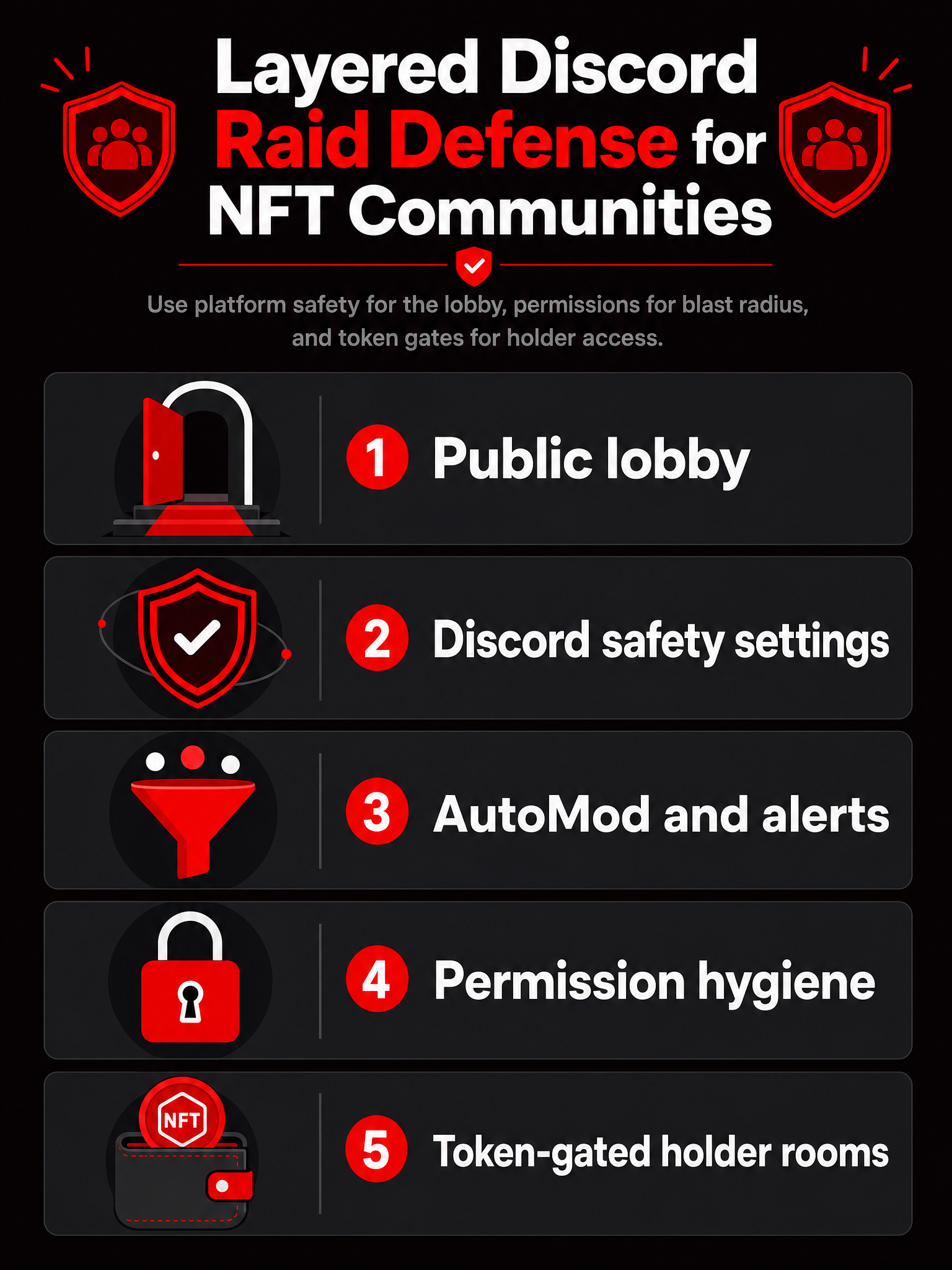
A raid-resistant NFT Discord uses layers: slow the front door, limit blast radius, and keep holder rooms tied to real Solana ownership.
What an anti-raid bot can and cannot do
An anti-raid bot is usually a moderation bot configured to watch for suspicious join patterns, message floods, mention spam, malicious links, repeated phrases, or sudden account activity. Some bots can timeout, kick, ban, lock channels, log events, or alert moderators.
That is useful. It is not magic.
Discord defines a raid as a large number of users or bots joining a server at once with disruptive or malicious intent, and its own guidance recommends built-in protections like AutoMod, disabling @everyone and @here for untrusted roles, Raid Protection alerts, verification levels, slowmode, Pause Invites, and raid reporting. (support.discord.com)
A bot cannot save a server with bad permissions.
The bot is one layer. Your real defense is the combination of:
- who can join
- who can speak
- who can post links
- who can ping roles
- who can create invites
- who can manage roles and bots
- who can see holder rooms
- who can write in announcement channels
- who gets alerted when activity spikes
For NFT communities, this matters beyond safety. A messy raid during launch week weakens social proof. Holders stop trusting announcements. New buyers hesitate. Mods burn hours cleaning instead of onboarding. Holder rooms turn into noise instead of conviction.
The layered anti-raid setup for NFT Discords
The best anti raid bot Discord strategy is not to ask one tool to do six jobs. Give each layer a clear job.
| Layer | Job | Example control | What it does not solve |
|---|---|---|---|
| Discord Safety Setup | Protect the server front door | Raid Protection alerts, Verification Level, Explicit Media Content Filter | Holder verification, staff compromise, bad role permissions |
| AutoMod | Stop spam before it lands | Block mention spam, custom keywords, spam filters, alerts | Every malicious message, every new scam phrase |
| Anti-raid or moderation bot | Add response automation | Join flood alerts, logs, timeouts, channel locks | Bad bot permissions, weak owner setup, fake official links |
| Permissions | Limit blast radius | Disable @everyone for untrusted roles, lock announcements, restrict invite creation | Wallet ownership, off-server scam DMs |
| Token gate | Protect holder rooms | NFT or SPL token ownership mapped to Discord roles | Public lobby raids, phishing intent, compromised moderators |
| Moderator runbook | Coordinate humans fast | Pause invites, slowmode, macros, report raid, post official notice | A server no one practiced operating |
Discord AutoMod can detect and block undesirable or risky content before it is posted, send alerts to a private channel, support keyword filters, and help with spam filtering. Discord also notes that moderation rules need tuning because each community has its own standards. (support.discord.com)
For a Solana NFT project, use the stack like this:
- Public lobby has limited permissions and platform-level safety.
- Announcement channels are locked and only post official links.
- Support channels use scripts, tickets, or controlled replies.
- Holder rooms require verified NFT or SPL token ownership.
- Mods have a raid runbook and a private alert channel.
Treat the public lobby as noisy by design. Treat the holder room as earned access.
Discord-native settings to enable before launch
Do the boring setup before the announcement, not during the raid.
1. Turn on AutoMod
Start with AutoMod in Server Settings > AutoMod. At minimum, configure:
- mention spam limits
- custom keywords for known scam phrases
- blocked words in usernames or nicknames when relevant
- alerts to a private mod-only channel
- timeout behavior for obvious raid patterns
Discord's raid guidance specifically recommends AutoMod for detecting and blocking undesirable messages, setting custom raid keywords, turning on alert responses, and using Block Mention Spam to reduce mention raids. (support.discord.com)
Do not overfit your launch vocabulary. NFT servers often have legitimate words like mint, claim, allowlist, snapshot, rarity, or staking. Blocking too aggressively can silence real holders during high-energy moments. Use alerts first where you are unsure, then block phrases that are clearly malicious.
2. Disable @everyone and @here for untrusted roles
Mass mentions create panic. Panic creates clicks.
Untrusted roles should not be able to mention @everyone, @here, or all roles. Discord recommends keeping that permission limited to trusted admins and moderators. (support.discord.com)
Also review role mentionability. A holder role does not need to be mentionable by everyone. In many servers, only team or mod roles should be able to ping high-value groups like Holder, Whale, OG, Allowlist, or Staker.
3. Set up Raid Protection alerts
Use Server Settings > Safety Setup > Raid Protection where available. Discord's raid guidance says Raid Protection can evaluate signals for join raids, alert a dedicated channel, and require CAPTCHA for new joiners after a detected raid, with availability notes depending on rollout. (support.discord.com)
Pick the alert channel carefully. It should be visible to active moderators, not buried in a private admin category that only founders read twice a week.
4. Use Verification Level as a throttle
For normal public growth, keep onboarding reasonable. During an active attack, raise friction.
Discord says verification levels can require email or phone verification and, at higher levels, can require more time before members interact. Discord recommends a basic level for public servers and increasing verification during a raid if needed. (support.discord.com)
This is an operating lever. Do not leave the server in emergency friction forever unless the community truly needs it.
5. Prepare Pause Invites
Pause Invites is one of the cleanest emergency controls because it stops new joins without forcing you to delete every invite link. Discord's FAQ says users with Manage Server can pause invites in Server Settings > Invites, existing links remain visible, and users cannot join until invites are re-enabled. (support.discord.com)
Use this when the join stream itself is the attack.
6. Use Activity Alerts and Security Actions
Discord Activity Alerts can warn admins and moderators about unusual activity, and Security Actions can pause invites and pause DMs between non-friends in the server while the team investigates. (support.discord.com)
That matters for NFT communities because many scam waves are not only channel spam. They also push members into fake support DMs, fake mint links, fake claim pages, and impersonated staff conversations.
Permission hygiene that limits raid damage
Most raid damage comes from boring mistakes.
Not sophisticated exploits. Not movie-hacker attacks. Just roles that can do too much.
Review these before every major campaign:
- @everyone cannot send messages in announcement channels.
- @everyone cannot mention @everyone, @here, or all roles.
- New members cannot post links in high-traffic lobby channels.
- Only trusted roles can create invites.
- Only trusted roles can manage webhooks.
- Only trusted roles can manage roles.
- Bots do not get Administrator unless there is a real reason.
- Bot roles sit below admin and owner roles in the hierarchy.
- Moderator roles are separated from founder and owner roles.
- Announcement channels are write-locked to a tiny group.
- Partnership channels cannot post unscreened links.
- Support channels include official anti-DM warnings.
Every bot you add becomes part of your security model.
Unknown anti-raid bots are especially risky when teams grant broad permissions because setup is faster. Least privilege is slower on day one, but it saves you from turning a protection bot into a damage multiplier.
For more server-wide scam controls, pair this guide with How to Stop Scammers in Your Crypto Discord Server. That article goes deeper on official links, impersonation, scam reporting, moderator workflows, and announcement discipline.
Where token gating protects holder rooms
Token gating should not be sold as total raid protection. It is more specific and more useful than that.
A token gate protects the holder boundary.
For a Solana NFT community, the usual flow is:
- A member joins Discord.
- The member verifies by signing a gasless wallet message to prove wallet control.
- The gate checks whether the wallet holds the required Metaplex NFT or SPL token.
- The member receives the correct Discord role, such as Holder, Whale, Staker, OG Holder, or DAO Member.
- Recurring checks keep access aligned with holdings.
- When the wallet no longer qualifies, access can be removed.
Ancla's official site describes gating Telegram and Discord communities to token holders, setting rules, auto-verifying holders, and removing sellers; it also describes migration where holders keep roles and sellers are removed automatically. (ancla.club)
Token gating protects the room, not every person in the room.
A verified holder can still post nonsense. A compromised holder can still click a bad link. A malicious buyer can still enter if they actually hold the asset. That is why token-gated Discord roles should sit alongside AutoMod, permissions, link restrictions, reporting flows, and human moderation.
The win is quality control:
- fewer fake holders arguing in holder chat
- less screenshot-based manual verification
- cleaner holder segmentation for announcements
- better retention rituals for real owners
- clearer social proof during launch and post-reveal
- less support work when people buy, sell, or move assets
For a deeper explanation of holder access rules, read Solana Token Gating: The Complete Guide for Community Founders. For the Discord role workflow, read How to Set Up Token-Gated Discord Roles on Solana.
NFT teams that also run Telegram should keep access aligned there too. Discord is better for structured channels, roles, logs, onboarding, and support. Telegram is better for fast holder coordination and mobile urgency. The same ownership logic should protect both when both are used.
Raid response runbook for moderators
A raid runbook should be short enough to use while the server is on fire.
Here is a practical order of operations.
First 2 minutes: stop the incoming damage
- Confirm the raid in the private alert channel.
- Pause invites if new joins are flooding in.
- Use Security Actions to pause DMs between non-friends if scam DMs are part of the attack.
- Increase Verification Level temporarily.
- Turn on or tighten slowmode in public channels.
- Lock the worst-hit public channels if needed.
Discord's own raid guidance lists Pause Invites, slowmode, AutoMod tuning, raising verification, and reporting the raid as de-escalation steps. (support.discord.com)
Next 10 minutes: protect members from confusion
- Post one official status message in announcements.
- Pin the official links page.
- Remind members that staff will not DM first.
- Tell holders where to talk if the public lobby is locked.
- Keep the message short. During a raid, long explanations get skimmed.
Use a prewritten macro:
Raid notice: We are seeing spam and fake links. Do not click links from DMs. Official links are pinned in #official-links. We may pause invites or slow channels while mods clean up. Holder rooms remain available to verified holders.
Next 30 minutes: clean and document
- Ban or timeout obvious raiders.
- Save logs and screenshots for internal review.
- Add repeated phrases to AutoMod rules.
- Review which invite links were abused.
- Check which channels had too much exposure.
- Report the raid through Discord where available.
- Write a short incident note for the team.
Discord says Report Raid is available from the server dropdown for Community servers and requires Ban Members or Kick Members permissions. (support.discord.com)
After the raid: fix the system
Do not just celebrate that the spam stopped.
Ask:
- Which permission allowed the most damage?
- Which channel should have been locked earlier?
- Which alert did mods miss?
- Which official link confused members?
- Which bot had more permissions than needed?
- Which holder role should have had cleaner access?
- Which support macro would have saved time?
This is where good community teams compound. Every incident becomes a cleaner operating system.
Common mistakes NFT teams make
Mistake 1: Searching for the best anti-raid bot instead of designing the system
The better question is not which bot is best. It is what your server allows a new, untrusted, or automated account to do.
A strong anti-raid bot on top of loose permissions is still a weak server.
Mistake 2: Making the public lobby too trusted
Your public lobby should be useful, but not powerful.
Let people ask basic questions. Do not let them mass ping, post links freely, create invite chaos, or bury official announcements.
Mistake 3: Using holder verification as a one-time event
One-time verification creates stale access. People sell, transfer, consolidate wallets, stake, unstake, or move assets. Holder rooms should reflect current ownership rules, not old screenshots.
Recurring checks matter because access needs to match the chain.
Mistake 4: Forgetting impersonation and DM scams
A quiet channel does not mean members are safe. Many attacks move into DMs.
Publish official links. Repeat that staff will not DM first. Train mods to direct members back to public, verifiable channels. Use Security Actions when unusual DM activity appears.
Mistake 5: Overloading verification friction during normal onboarding
Security friction has a cost.
Use strong friction where trust matters most: holder rooms, collab channels, support, high-value announcements, and post-mint areas. Keep public onboarding understandable unless the server is under attack.
Mistake 6: Giving every bot Administrator
This is one of the fastest ways to increase blast radius.
Review each bot's job. Logging bots need logging permissions. Verification bots need role assignment permissions for the roles they manage. Moderation bots need moderation permissions that match the actions they perform. Not every bot needs the keys to the server.
Final checklist
Before your next NFT launch, reveal, listing push, partnership announcement, or holder campaign, run this checklist.
Discord front door
- AutoMod is enabled.
- Mention spam protection is configured.
- Custom scam phrases are added carefully.
- Raid Protection alerts are pointed to a private channel.
- Verification Level is set for normal operations.
- Higher Verification Level is ready for emergencies.
- Pause Invites is understood by at least two mods.
- Activity Alerts and Security Actions are understood by the team.
Permissions
- @everyone and @here are disabled for untrusted roles.
- Announcement channels are locked.
- Invite creation is limited.
- Link posting is limited in public channels.
- Bot permissions are least privilege.
- Bot role hierarchy is reviewed.
- Moderator permissions are separated from founder permissions.
Holder rooms
- Holder access is based on Solana NFT or SPL token ownership.
- Members prove wallet control with a gasless signature.
- Discord roles are mapped to clear ownership rules.
- Recurring checks remove access when holdings no longer qualify.
- Telegram holder access is aligned if the community uses Telegram.
- Support macros explain verification without turning it into an identity check.
Moderator workflow
- A raid runbook exists.
- A private alert or log channel exists.
- Official links are pinned and easy to find.
- Mods know when to pause invites.
- Mods know when to slow or lock channels.
- Mods know how to report scams and raids.
- Post-incident review is part of the process.
The safest NFT Discords are not the ones with the loudest bot stack. They are the ones where the public lobby has limited blast radius, the holder room is gated by real ownership, and moderators know exactly what to do when the join wave starts.
Try Ancla free at ancla.club/select-plan.
Trusted by Solana communities running on Ancla


Frequently asked questions
There is no single best answer for every NFT Discord. A good anti-raid bot can help with alerts, logging, timeouts, channel locks, and spam response, but the safer setup is layered: Discord Safety Setup, AutoMod, strict permissions, controlled invites, token-gated holder rooms, and a moderator runbook.
Token gating does not stop every raid. It protects gated areas by checking whether a member controls a wallet that holds the required Solana NFT or SPL token. Public channels still need Discord-native raid protection, AutoMod, permission hygiene, official links, and active moderation.
Start with AutoMod, mention spam limits, locked announcement channels, disabled @everyone and @here for untrusted roles, Raid Protection alerts where available, an appropriate Verification Level, a private alert channel, and a clear plan for Pause Invites and Security Actions during active attacks.
Use wallet verification and token-gated Discord roles. A member signs a gasless message to prove wallet control, the verifier checks the wallet for the required Metaplex NFT or SPL token, assigns the correct Discord role, and recurring checks remove access when the wallet no longer qualifies.
Confirm the raid in a private alert channel, pause invites if new joins are flooding in, pause DMs if scam DMs are part of the attack, raise verification temporarily, enable slowmode or lock affected channels, post one official notice, remove obvious raiders, update AutoMod rules, and document what happened after cleanup.